
Journal of Multidisciplinary Research and Innovations
Advancing knowledge in multidisciplinary research and innovation through rigorous scholarship and cutting-edge insights. Published by ASUP-BD.
Published Articles
Countries Represented
Days Avg. Review Time
Acceptance Rate
Ready to Get Started?
Join our community of researchers and academics. Log in to your account or create one today.
Latest Articles
Discover the most recent contributions to multidisciplinary research and innovation
The stability of building foundations is threatened by soil erosion that occurs in areas where the terrain is prone to erosion by water and wind. This paper examines the effect of erosion on building structures below ground level in Bida Local Government, Niger State, Nigeria. The study employed a mixed-method approach using structured questionnaires and field observation checklists as instruments of data collection, with a total of 120 buildings sampled across three erosion-prone areas in Bida Local Government. Through field surveys, soil analysis, and interviews with stakeholders, the study determined the magnitude of subsurface damage resulting from erosion and its socio-economic impact on local residents. The results show that buildings in the erosion-prone areas are characterized by high subsidence and structural instability, with repair costs on the increase. The paper recommends that better drainage systems, soil stabilization methods, and erosion-resistant materials be adopted in construction to reduce future damage. These measures are crucial for maintaining building structural integrity and the safety of residents in Bida Local Government.
This study evaluated the factors contributing to building maintenance challenges in secondary schools within Bida, Niger State. The research was necessitated by the visible state of structural and cosmetic disrepair of educational infrastructure in the region, which poses a threat to both functional integrity and the safety of occupants. To achieve the study objectives, a cross-sectional survey design was adopted, targeting principals, vice-principals, and technical staff across selected public and private secondary schools. A structured questionnaires was administered, with 80% response rate. Data were analysed using descriptive statistics and the Mean Score index. The findings revealed that the most critical factors mitigating against effective maintenance are inadequate funding for spare parts and materials (Mean: 4.63), poor organisational structures (Mean: 4.63), and the influence of political factors leading to wrong technical decisions by non-experts (Mean: 4.53). Furthermore, the study established that 62.5% of respondents lacked formal maintenance orientation, leading to a predominantly reactive maintenance culture. The results concluded that current maintenance management practices in secondary schools in Bida are insufficient to protect the life cycle of school buildings. It was therefore recommended that the government and school management should establish dedicated maintenance intervention funds, professionalise the maintenance departments by involving built-environment experts, and implement mandatory preventive maintenance schedules to forestall rapid deterioration of facilities.
This study investigates the adoption of supply chain management (SCM) practices in Nigerian construction firms, with a focus on Abuja. The research identifies key practices and challenges faced by construction stakeholders in the region. Data was collected using a self-administered questionnaire, which predominantly consisted of closed-ended questions, and responses were measured on a five-point Likert scale. The findings reveal that the most commonly adopted SCM practices in the sector are focused on enhancing efficiency, particularly through the reduction of waste (MIS = 4.18), time (MIS = 4.10), and costs, alongside the sharing of knowledge and skills (MIS = 4.06). However, challenges such as the inability to integrate internal processes (MIS = 4.42) and resistance to change (MIS = 4.38) remain significant barriers to effective SCM implementation. The study highlights that while practices like waste reduction and knowledge sharing are widely adopted, key areas such as supplier relationships (MIS = 3.62), transparency (MIS = 3.68), and the adoption of new technologies (MIS = 2.63) are underdeveloped. The research underscores the need for a more integrated approach to SCM, with a focus on fostering long-term partnerships and embracing technological advancements. Based on these findings, the study recommends improving collaboration, investing in technological solutions, implementing robust change management strategies, providing ongoing training, and strengthening supplier development to enhance SCM practices and overall efficiency in the Nigerian construction industry.
Quick Access
Everything you need to engage with our journal
Why Publish With Us
Join a growing community of researchers committed to advancing multidisciplinary knowledge
Fast Review Process
Average review time of 4-6 weeks with dedicated editorial support throughout the process.
Global Reach
Open access publication ensures your research reaches readers worldwide without barriers.
Quality Assurance
Rigorous double-blind peer review maintains the highest standards of scholarly publishing.
Latest News & Updates
Stay informed with the latest announcements, calls for papers, and journal news
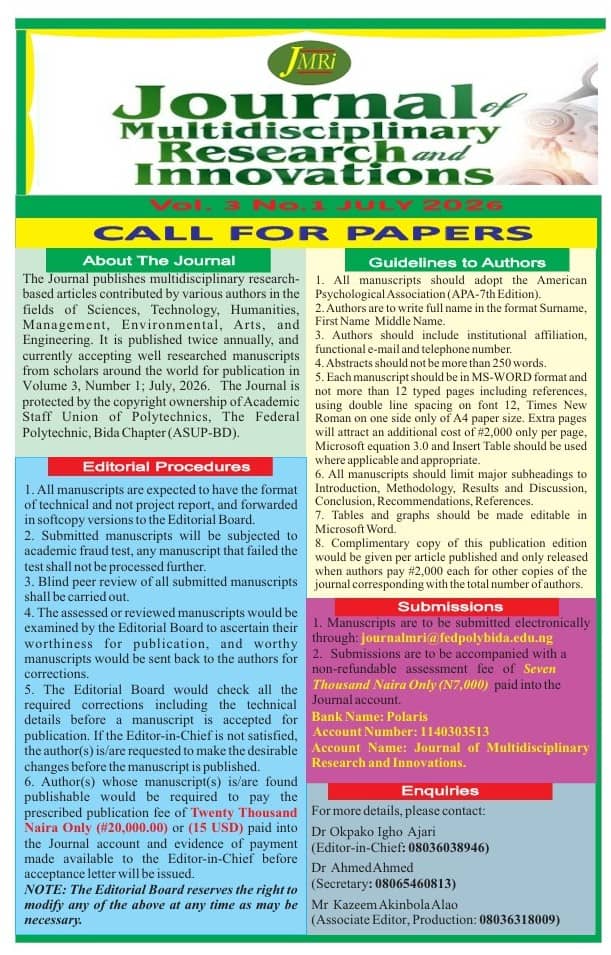
Are you a researcher, academic, or graduate student looking for a reputable platform to publish your work in 2026? The Journal of Multidisciplinary Research and Innovations (JMRI) has officially released its Call for Papers for Volume 3, Number 1, scheduled for publication in July 2026.
Meet Our Editorial Team
Distinguished scholars and experts guiding the quality and direction of JMRI
O.I Ajari
Editor-in-Chief
The Federal Polytechnic, Bida
Editorial BoardC.U Ibeme
Deputy Editor-in-Chief
The Federal Polytechnic, Bida
Editorial BoardS.B Gognaje
Associate Editor (Vetting)
The Federal Polytechnic, Bida
Editorial BoardOmodele Abiodun Abosede Eletta
Advisory Board
Department of Chemical Engineering, University of Ilorin
Advisory BoardOur Scope
JMRI publishes high-quality multidisciplinary research spanning the sciences, humanities, technology, health, education, business, and the environment. We welcome rigorous studies that connect disciplines and offer meaningful insight for researchers, practitioners, communities, and policymakers.
Science & Technology
Social Sciences & Humanities
Health & Education
Business & Environment
Ready to Share Your Research?
Join hundreds of researchers who have published their work with JMRI. Start your submission today.